X-RAY DIFFRACTION (XRD) FOR THIN FILM
DOWNLOAD REQUEST FORM HERE


INSTRUMENT NAME & MODEL: Thin Film X-Ray Diffraction (XRD) (D8 Discover, Bruker)
Thin film X-ray diffraction (XRD) techniques were used to analyze structural properties such as crystallinity, lattice parameters, strain, and thickness. Measurements were conducted using a Bruker diffractometer equipped with precision optics and controlled through DIFFRAC.SUITE software.
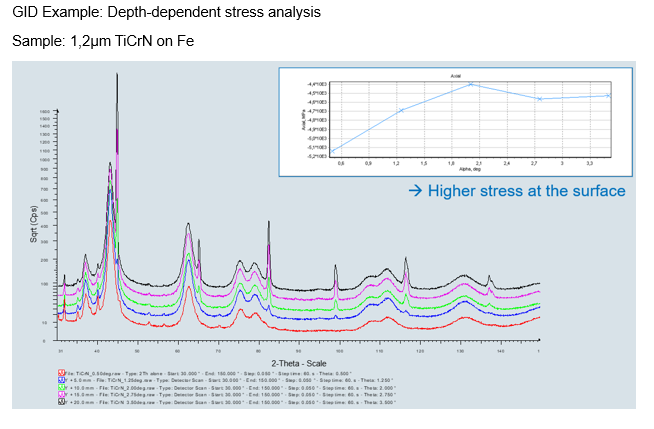
Grazing-Incidence Diffraction (GID / GIXRD) was employed to probe near-surface and in-plane structures using shallow incident angles close to the critical angle, minimizing substrate effects. Phase identification and lattice analysis were performed with DIFFRAC.EVA.
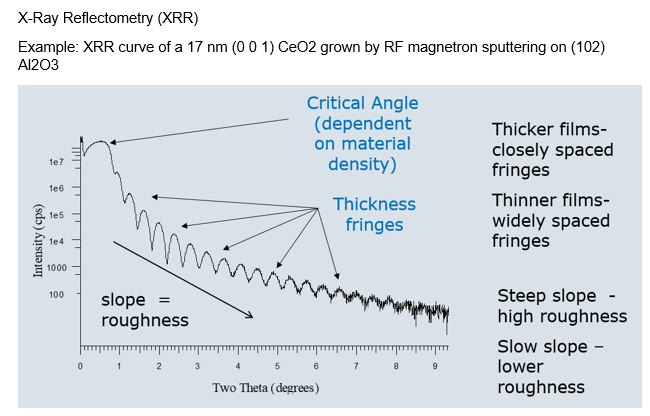
X-ray Reflectivity (XRR) provided film thickness, density, and interface roughness. Reflectivity profiles were modeled in Bruker DIFFRAC.LEPTOS using the Parratt formalism with least-squares refinement, achieving sub-nanometer accuracy.
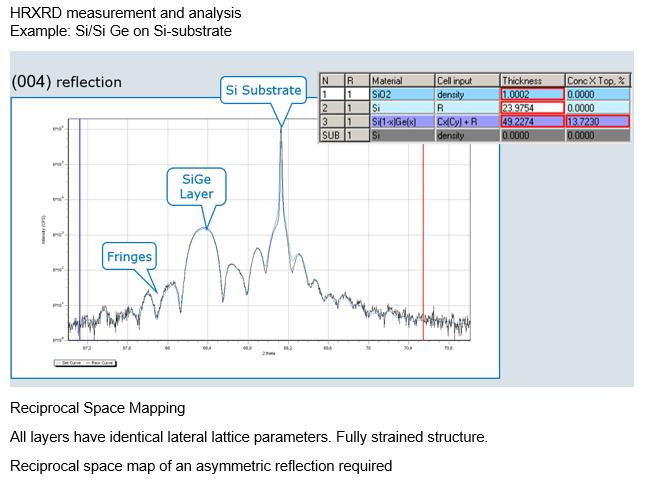
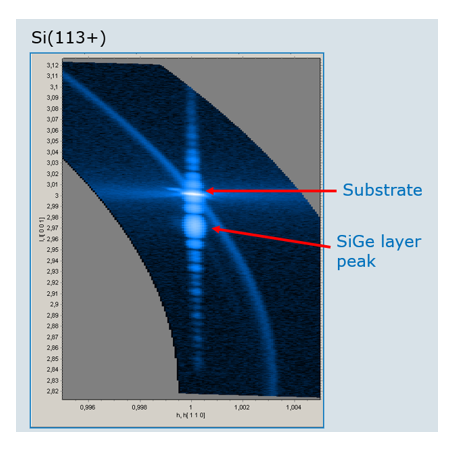
High-Resolution XRD (HRXRD) and Reciprocal Space Mapping (RSM) characterized epitaxial layers, determining strain, relaxation, and crystalline quality. Data were processed in DIFFRAC.LEPTOS for quantitative lattice and strain analysis.
Small-Angle X-ray Scattering (SAXS) measurements were performed on a Bruker D8 DISCOVER diffractometer configured for small-angle analysis. SAXS revealed nanoscale morphology, particle size, and spatial distribution, with data modeled using DIFFRAC.SAXS analysis.
Together, these complementary X-ray techniques enabled comprehensive, non-destructive characterization of thin film structure and interface quality.
CATEGORY: Material/Nanomaterial Characterization

Special Features
-
-
-
SPECIAL FEATURES
- Multi X-ray techniques including GID, XRR, HRXRD, and SAXS
• TRIO and TWIN optics
Fully automatic, motorized switching between up to 6 different beam geometries without any manual user intervention
- Centric Eulerian Cradle – 2 rotation axis (Phi, Psi), 3 translation axis (X,Y,Z)
• Alignment Guarantee
performance verification with NIST corundum standard SRM 1976
Minimum spot size analysis of 15 um.
- Multi X-ray techniques including GID, XRR, HRXRD, and SAXS
-
-

Applications
- Phase Identification & Quantification
- Grazing Incidence Diffraction
- X-ray Reflectometry
- Small Angle X-ray Scattering
- High-Resolution X-ray Diffraction
SAMPLE REQUIREMENTS
- Thin Films on Flat Substrate
- Film thickness range: 5 nanometers to 2 µm.
- Film materials: metals, oxides, nitrides, semiconductors, polymers, perovskites, etc.
- For HRXRD, Substrate orientation must be well known
Typical Results
RESULT
- Data, pictures/images with some explanation
- Tables/graphs etc.
All enquiries please contact:

