X-RAY DIFFRACTION (XRD) FOR POWDER
DOWNLOAD REQUEST FORM HERE


INSTRUMENT NAME & MODEL: Powder X-ray Diffraction (PXRD) (D8 Advance ECO, Bruker)
Powder X-ray Diffraction (PXRD) is a commonly used technique in materials science for identifying and analyzing the crystal structures of solid materials. In many university research laboratories, Bruker diffractometers are employed because they offer reliable performance, high precision, and user-friendly software for both data collection and analysis.
In PXRD, a beam of X-rays is directed onto a powdered sample. The X-rays interact with the crystal planes in the material, and when specific geometric conditions are met, constructive interference occurs, producing diffraction peaks. This phenomenon is described by Bragg’s Law, expressed as nλ = 2d sin θ, where n is the order of reflection, λ is the wavelength of the X-rays, d is the spacing between crystal planes, and θ is the diffraction angle. By measuring these diffraction angles and intensities, the crystal structure of the material can be determined.
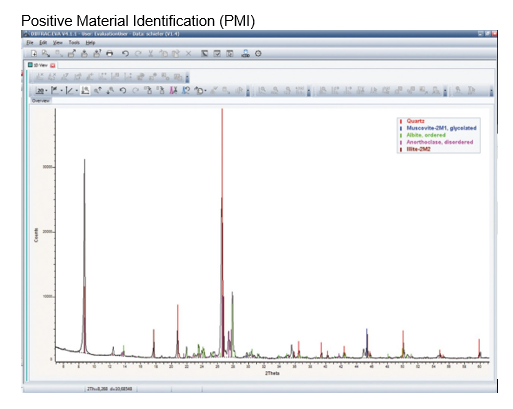
The Bruker diffractometer ensures accurate alignment and stable operating conditions to obtain high-quality data. The resulting diffraction pattern acts as a structural “fingerprint” that can be compared with reference databases such as the ICDD Powder Diffraction File (PDF) to identify the phases present. PXRD can also provide valuable information about crystallite size, lattice parameters, and the degree of crystallinity. Because of its precision, versatility, and relative ease of use, PXRD has become a fundamental technique for materials characterization in university research.
CATEGORY: Material/Nanomaterial Characterization, Chemical & Elemental Analysis

Special Features
-
SPECIAL FEATURES
- Dynamic Beam Optimization
Data virtually free of air, instrument, and sample support scattering
• LYNXEYE XE-T Detector100% filtering of Fe-fluorescence with Cu radiation
• AUTOCHANGER45 different samples can be measured continuously
- ICDD PDF 5+
world’s most comprehensive Powder Diffraction File™ (PDF®) database with 1,126,200+ entries! PDF-5+ contains 472,300+ inorganic and 657,700+ organic entries
- Alignment Guarantee
performance verification with NIST corundum standard SRM 1976

Applications
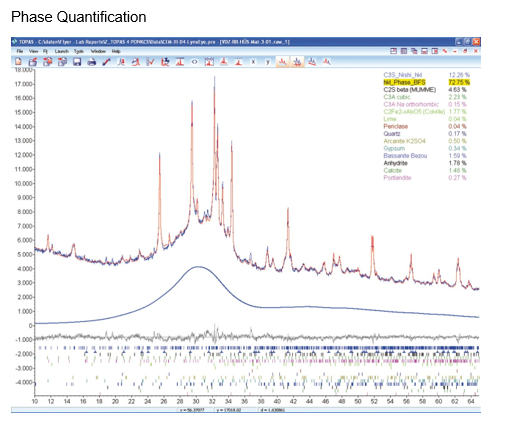
- Phase Identification & Quantification
- Microstructure Analysis
- Crystal Structure Determination & Refinement
SAMPLE REQUIREMENTS
- Finely ground, homogeneous powder < 75 µm.
- Dry
- Crystalline
Typical Results
RESULT
- Data, pictures/images with some explanation
- Tables/graphs etc.
All enquiries please contact:

